|
|
|
|
|
|
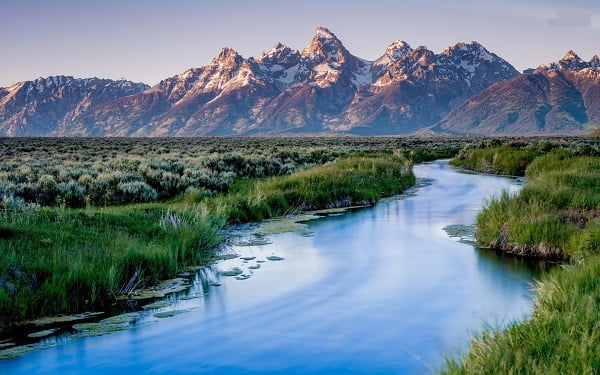
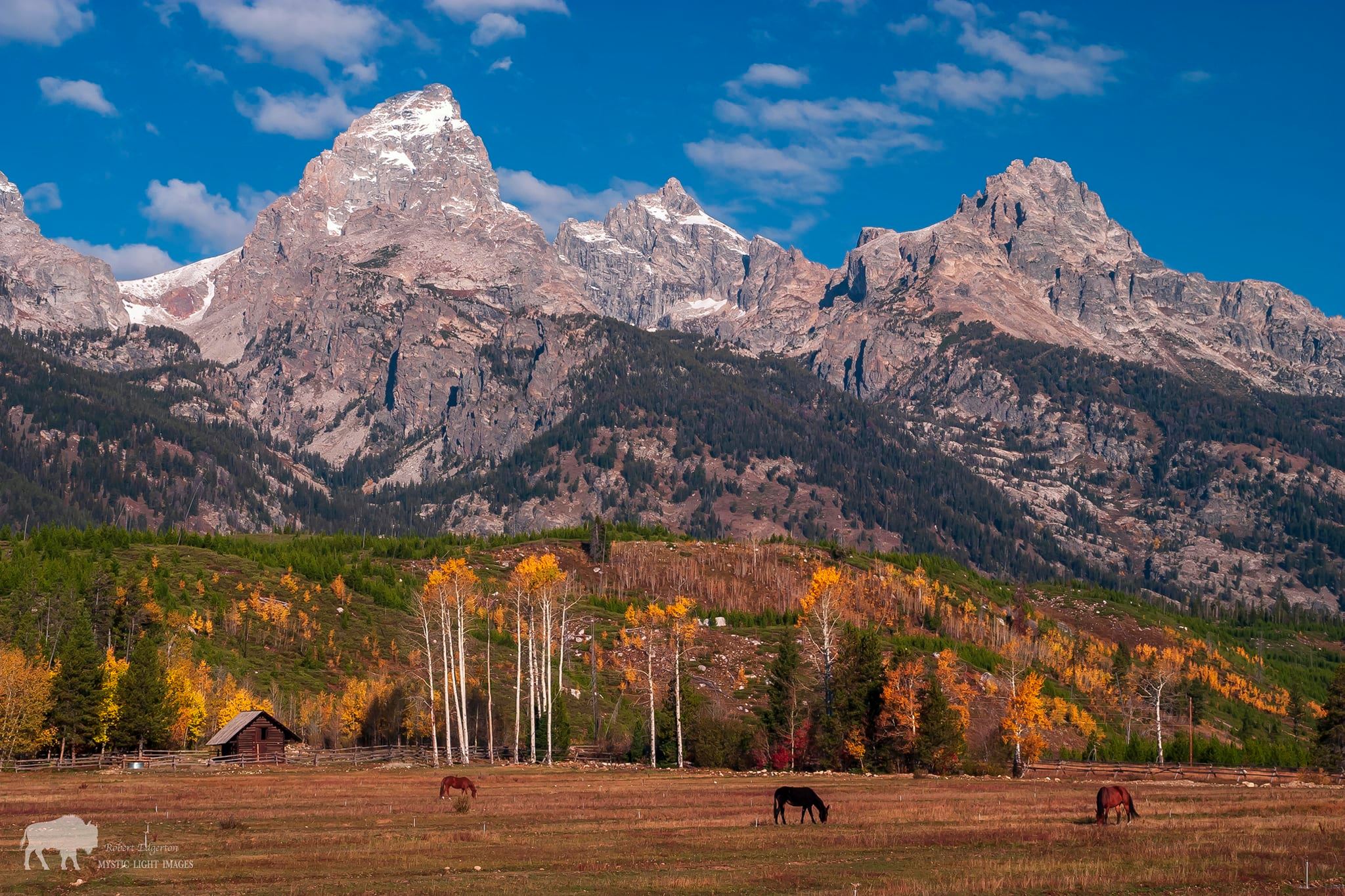
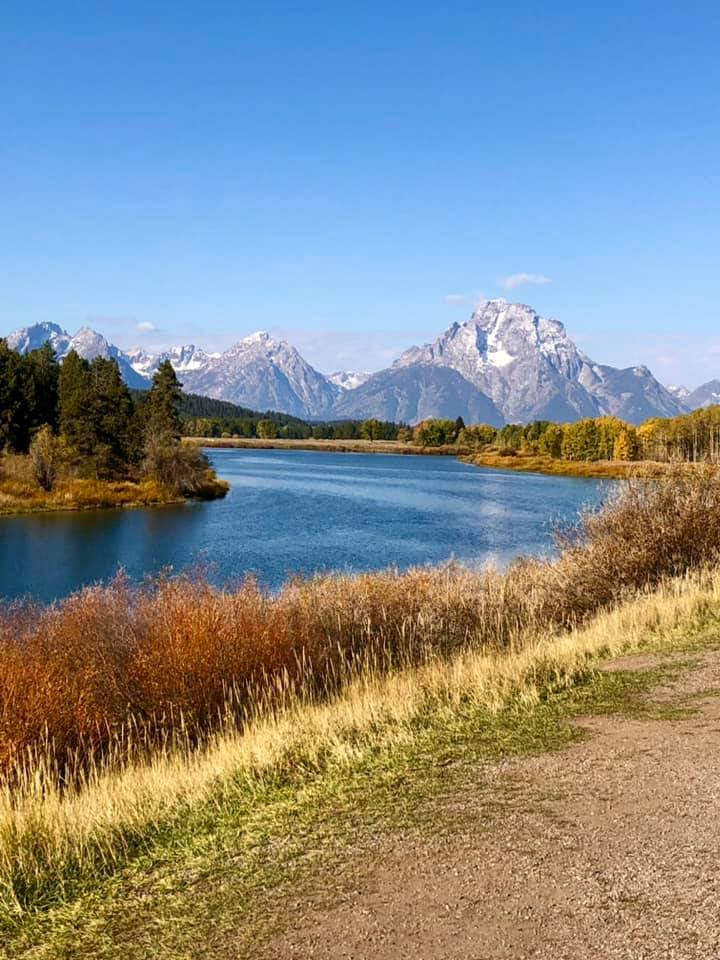
Teton Range - An active fault-block mountain front, 40 miles long (65 km), 7-9 miles wide (11-14.5 km).
Highest peak - Grand Teton, elevation 13,770 feet (4198 m). Twelve peaks over 12,000 ft (3658 m) in elevation.
Jackson Hole - Mountain valley, 55 miles long (89 km), 13 miles wide (21 km), average elevation 6,800 feet (2073 m). Lowest elevation at south park boundary, 6350 feet (1936 m).
Climate - Semi-arid mountain climate. Extreme high: 93 degrees F (34 degrees C). Extreme low: -46 degrees F (-43 degrees C).
Average snowfall - 191 inches (490 cm). Avg. rainfall: 10 inches (26 cm).
Snake River - Headwaters of the Columbia River system, 1056 miles long. Approximately 50 miles lie within Grand Teton NP. Major tributaries: Pacific Creek, Buffalo Fork, and Gros Ventre River.
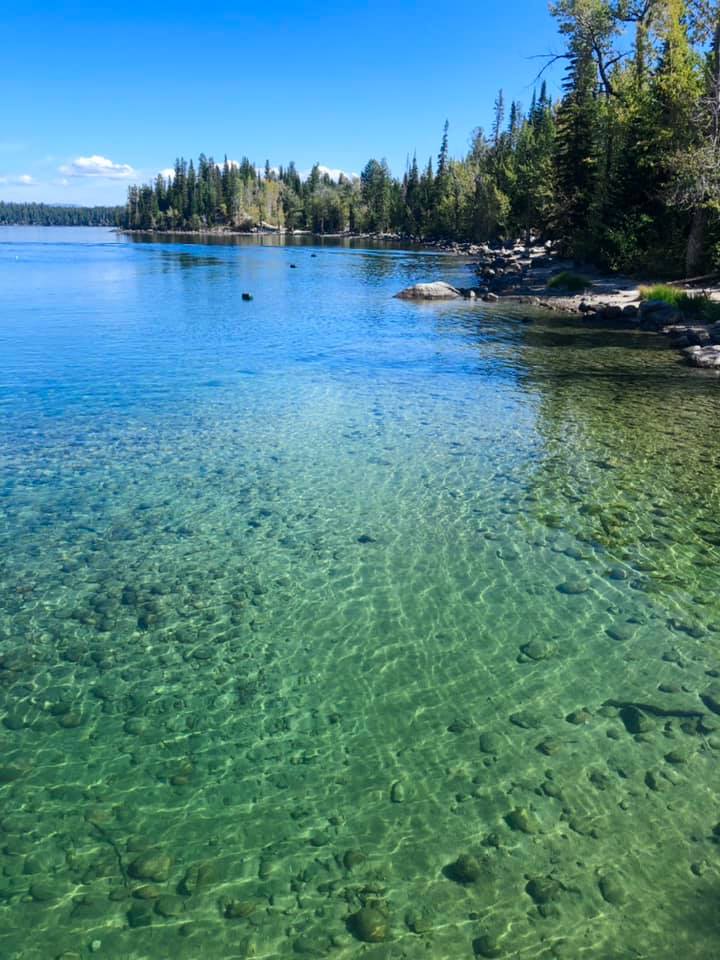
Lakes - Seven morainal lakes at the base of the Teton Range: Jackson, Leigh, String, Jenny, Bradley, Taggart, and Phelps. Jackson Lake: 25,540 acres (10,340 hectares) maximum depth 438 feet (134 m). Over 100 alpine and backcountry lakes.
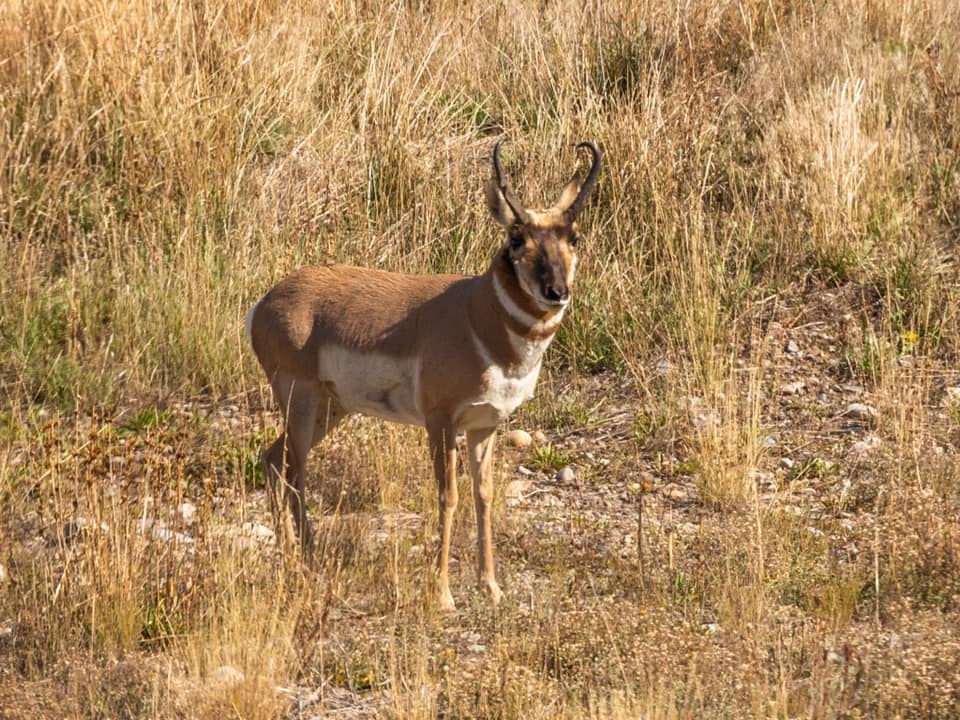
Wildlife -
The original Grand Teton National Park was established by Congress on February 29, 1929. (45 Stat., 1314).
The birth of present-day Grand Teton National Park involved controversy and a struggle that lasted several decades. Animosity toward expanding governmental control and a perceived loss of individual freedoms fueled anti-park sentiments in Jackson Hole that nearly derailed establishment of the park. By contrast, Yellowstone National Park benefited from an expedient and near universal agreement for its creation in 1872. The world's first national park took only two years from idea to reality; however Grand Teton National Park evolved through a burdensome process requiring three separate governmental acts and a series of compromises:
The original Grand Teton National Park, set aside by an act of Congress in 1929, included only the Teton Range and eight glacial lakes at the base of the mountains.
The Jackson Hole National Monument, decreed by Franklin Delano Roosevelt through presidential proclamation in 1943, combined Teton National Forest acreage, other federal properties including Jackson Lake and a generous 35,000-acre donation by John D. Rockefeller, Jr. The Rockefeller lands continued to be privately held until December 16, 1949 when impasse for addition to the National Park was resolved.
On September 14, 1950, the original 1929 Park and the 1943 National Monument (including Rockefeller's donation) were united into a "New" Grand Teton National Park, creating present-day boundaries.
Grand Teton National Park was established to protect the area's spectacular scenic values, as characterized by the geologic features of the Teton Range and Jackson Hole, and the native plant and animal life.
The park was enlarged to its present size by Congress on September 14, 1950, (Public Law 81-787, 64 Stat. 849) to include a portion of the lands within Jackson Hole National Monument. The national monument had been established by Presidential Proclamation (No. 2578, 57 Stat. 731) on March 15, 1943.
Early pioneers and environmentalists wanted to expand Yellowstone to include some the beautiful primitive areas surrounding its borders. Most of these ideas were defeated as extensions of Yellowstone. But the area south of Yellowstone, today known as Grand Teton National Park was established as a part of the original idea to expand Yellowstone. Also, thanks to John D. Rockefeller, the lands between Yellowstone and Grand Teton National Parks was purchased and given to us to help preserve this vast western wilderness.
Public Law 92-404 established the Parkway on August 25, 1972, ". . . for the purpose of commemorating the many significant contributions to the cause of conservation in the United States, which have been made by John D. Rockefeller, Jr., and to provide both a symbolic and desirable physical connection between the world's first national park, Yellowstone, and the Grand Teton National Park."
As early as 1897, Colonel S.B.M. Young, acting Superintendent of Yellowstone, proposed to expand Yellowstone's boundaries southward to encompass portions of northern Jackson Hole and protect migrating elk herds. In 1898 Charles D. Walcott, head of the U.S. Geological Survey, made a similar proposal, suggesting that the Teton Range be included as well as northern Jackson Hole. Neither the Interior Department nor Congress acted on either of these proposals.
In 1916, a new bureau called the National Park Service was created within the Department of Interior. This bureau could promote park ideas both locally and at the national level with the creation of a Washington DC office. Director of the National Park Service, Stephen Mather and his assistant, Horace Albright affirmed their commitment toward park expansion in a 1917 report to Secretary of the Interior, Franklin Lane. The report stated that adding part of the Tetons, Jackson Lake, and headwaters of the Snake River to Yellowstone National Park is "one of seven urgent needs facing the Park Service." Mather and Albright worked with the Wyoming congressional delegation to draft a bill addressing expansion of Yellowstone's boundaries into the Teton country. Congressman Frank Mondell of Wyoming introduced the bill in 1918. The House unanimously approved a revised bill in 1919. However, the bill died in the Senate when Idaho Senator John Nugent feared the loss of sheep grazing permits with expanded park service jurisdiction.
As historian Robert Righter states, "an opportunity had been lost. Never again would park extension be so non-controversial."
In addition to Idaho sheep ranchers, other groups opposed park extension, these included regional U.S. Forest Service personnel, Jackson Hole businessmen, and some area ranchers. In 1919 Yellowstone Superintendent, Horace Albright was unaware of the pervasive anti-park attitude in Jackson Hole. As a result, he was practically "run out of town" when he traveled to Jackson to promote his park enlargement vision. Ranchers worried that park extension would reduce grazing allotments; Forest Service employees feared the loss of jurisdiction on previously managed forest areas; and local dude ranchers were against improved roads, hotel construction and concessioner monopolies.
Proposals emerged to dam outlets of Jenny Lake and Emma Matilda and Two Ocean Lakes in 1919. Alarmed businessmen and ranchers felt that some form of protection by the National Park Service might be their only salvation from commercialization and natural resource destruction. Eventually, local and National Park Service interests merged at an historic meeting in Maud Noble's cabin on July 26, 1923. Participants included Yellowstone Superintendent, Horace Albright; Bar BC dude ranchers, Struthers Burt and Horace Carncross; newspaperman, Dick Winger; grocery storeowner, Joe Jones; rancher, Jack Eynon; and ferry owner, Maud Noble. They devised a strategy. Their plan sought to find private funds to purchase private lands in Jackson Hole and create a recreation area or reserve that would preserve the "Old West" character of the valley, basically creating a "museum on the hoof." With the exception of Horace Albright, the attendees did not support a national park, "because they wanted traditional hunting, grazing, and dude-ranching activities to continue." In 1928, a Coordinating Commission on National Parks and Forests met with residents of Jackson and reached consensus for park approval. Local support and the Commission's recommendations led Senator John Kendrick of Wyoming to introduce a bill to establish Grand Teton National Park. Senator Kendrick stated that once he viewed the Tetons he "realized that some day they would become a park dedicated to the Nation and posterity…" Congress passed Senator Kendrick's bill. On February 26, 1929, President Calvin Coolidge signed this bill creating a 96,000-acre park that included the Teton Range and eight glacial lakes at the base of the peaks. Since this fledgling 1929 park did not safeguard an entire ecosystem, Albright and the other participants of the 1923 meeting continued to pursue their dream of seeking private funds to purchase private lands in Jackson Hole.
John D. Rockefeller, Jr. became involved in the Jackson Hole Plan after a visit to Teton country in 1924 and again in 1926. These visits highlighted not only spectacular Teton scenery, but also shabby developments littering the roadway from Menor's Ferry to Moran and along Jenny Lake's south and east shores. Yellowstone Superintendent Albright seized an opportunity to explain to Rockefeller the essence of the Noble cabin meeting and the hope of protecting and preserving "this sublime valley" from unsightly commercial development. Rockefeller decided to purchase offending private properties with the intention of donating these lands for National Park designation. He created the Snake River Land Company as a purchasing agent to mask his association and keep land prices affordable, since landowners would have undoubtedly inflated their asking prices had they known of his involvement.
The Snake River Land Company launched an ambitious campaign to buy more than 35,000 acres for approximately $1.4 million. What seemed like a simple and straightforward plan became 20 years of bitter debate, nearly tearing apart the Jackson Hole community. Intense hostility surrounded land acquisitions; attempts by Rockefeller to gift these properties to the National Park Service met resistance. Economic hardships suffered by ranchers during the 1920's helped ease some land acquisitions. Many ranchers were actually relieved to sell and get out of business during a time of economic difficulty. In 1925, ranchers circulated a petition in support of the private buy out countering anti-park opinions in Jackson Hole. Ninety-seven ranchers endorsed the petition's statement, "that this region will find its highest use as a playground…The destiny of Jackson's Hole is as a playground, typical of the west, for the education and enjoyment of the Nation, as a whole." Perhaps this quote has more credibility as a tacit admission that ranching in northern Jackson Hole was difficult, if not impossible, than it has as a genuine altruistic gesture by the ranchers.
Because allegations were made that the Snake River Land Company used illegal tactics during the purchase of properties, a Senate Subcommittee convened hearings in 1933 to investigate. When the hearings concluded, it was clear that claims about unfair business dealings by the Snake River Land Company and the National Park Service were groundless and both were exonerated. In 1934, Wyoming Senator Robert Carey introduced a bill in the Senate once again to expand park boundaries. One compromise of this bill dealt with reimbursement to Teton County for lost tax revenues. This bill and another drafted in 1935 failed. The tax issue and objections to including Jackson Lake because of dam and reservoir degradation fueled anti-park sentiments anew. During 1937 and 1938, the National Park Service prepared a document outlining the history of park extension and defending the importance of park status upon tourism. Again, anti-park sentiments flared and the expansion issue grew politically hotter. A group of locals calling themselves the Jackson Hole Committee vehemently opposed the park plan and encouraged the Wyoming delegation and Congress to do so as well. The park dream remained bruised and battered as controversy over enlargement continued into the 1940s.
After purchasing 35,000 acres and holding the land for 15 years, John D. Rockefeller, Jr. became discouraged and impatient with the stalemate surrounding acceptance of his gift. In an historic letter to President Franklin Delano Roosevelt, he wrote that if the federal government did not want the gift of land or could not "arrange to accept it on the general terms long discussed…it will be my thought to make some other disposition of it or to sell it in the market to any satisfactory buyers." This threat persuaded FDR to use his presidential power to proclaim 221,000 acres as the Jackson Hole National Monument on March 15, 1943. Robert Righter believes that Rockefeller threatened to sell in order to provoke governmental action. This bold action by Roosevelt provided a chance to circumvent obstacles created by Congress and the Wyoming delegation.
Local backlash immediately followed as park opponents criticized the monument for being a blatant violation of states' rights. They also believed the monument would destroy the local economy and county tax base. Hoping to force a confrontation, armed and defiant ranchers trailed 500 cattle across newly created monument land. The Park Service ignored this stunt but the drive focused national attention on the monument. Controversy grew more vocal and bitter, causing Wyoming Congressman Frank Barrett to introduce a bill abolishing the Jackson Hole National Monument; it passed both House and Senate. President Roosevelt exercised a pocket veto, killing the bill. The state of Wyoming responded to the veto by filing suit against the National Park Service to overturn the proclamation. The suit failed in the court system but the acrimonious local rift continued. The proclamation directed transfer of acreage from the Teton National Forest to the National Park Service. Since forest service administrators opposed the monument, the transition between jurisdictions provoked several vindictive deeds; one vengeful act involved gutting the Jackson Lake Ranger Station before turning it over to park staff. Local park supporters often faced hostilities and boycotts of their businesses throughout these turbulent years.
After World War II ended, the sentiment began to change in Jackson Hole. Between 1945 and 1947, bills were introduced in Congress to abolish the monument, but none passed. Local citizens began to realize that tourism offered an economic future for Jackson Hole. Eventually, attitudes became more agreeable toward park enlargement. By April 1949, interested parties had gathered in the Senate Appropriation Committee chambers to work out a final compromise. Though it took decades of controversy and conflict, discord and strife, the creation of a "New" Grand Teton National Park finally occurred on September 14, 1950, when Harry S. Truman signed a bill merging the 1929 park with the 1943 monument to form an enlarged 310,000-acre park. Preservation of the Teton Range, Jackson Lake, and much of Jackson Hole was finally placed in the hands of the National Park Service as a more complete ecosystem.
Difficulties of park-making define Grand Teton National Park and emphasize the visionary ideology of Horace Albright, John D. Rockefeller, Jr. and several pro-park residents. Legislation for the new park contained significant compromises:
Congress enlarged the park to its present size in 1950, "…for the purpose of including in one national park, for public benefit and enjoyment, the lands within the present Grand Teton National Park and a portion of the lands within Jackson Hole National Monument." The conservation battle for Jackson Hole coupled with the philanthropic dedication of John D. Rockefeller, Jr. shapes the character of this valley to the present day. Imagine how different the Teton landscape would look if unbridled development had prevailed over preservation of natural resources. In celebrating the Fiftieth Anniversary of Grand Teton National Park, we recognize and honor the dedication, perseverance and aspirations of visionary men and women who believed that the greatest good for the Teton countryside was as a "public park or pleasure ground for the benefit and enjoyment of the American people." As Crucible for Conservation author Robert Righter suggests, what these visionaries achieved was "perhaps the most notable conservation victory of the twentieth century."
The Creation of Grand Teton National Park was written in January 2000 by Jackie Skaggs, 50th Anniversary Coordinator, with research, references, and quotations taken from A Place Called Jackson Hole by John Daugherty, Park Historian 1980-1991 and from Crucible For Conservation by Robert Righter, currently research professor of history at Southern Methodist University in Texas.
The park encompasses approximately 310,000 acres of wilderness and some of the most beautiful mountain scenery in the western United States. John D. Rockefeller, Jr. Memorial Parkway legislation established an 82 mile parkway between West Thumb in Yellowstone National Park and the south entrance of Grand Teton National Park. This area included approximately 24,000 acres of land.
There is approximately 100 miles of paved roads in the park.
There is nearly 200 miles of trails for hikers to enjoy in Grand Teton National Park.
The Earliest Visitors
Archeological studies established human occupation of Jackson Hole for at least 11,000 years. Knowledge of early people is extremely limited. Data suggests that they used the area from spring to fall, based on seasonal availability of resources. Prehistoric people crossed the passes into Jackson Hole en route to seasonal hunting grounds in the region. In historic times, Indian tribes such as the Shoshoni, Gros Ventre, Flathead and Blackfeet knew the Teton country.
Days of Mountain Men
The splendor of the Teton Mountains first dazzled fur traders. Although evidence is inconclusive, John Colter probably explored the area in 1808. By the 1820's, mountain men followed wildlife and Indian trails through Jackson Hole and trapped beaver in the icy waters of the valley.
The term "hole" was coined by fur trappers of the 1820s to describe a high altitude plateau ringed by mountains. Thus, Jackson Hole is the entire valley, 8 to 15 miles wide and 40 miles long. The valley was named for David E. Jackson, a trapper who reputedly spent the winter of 1829 along the shore of Jackson Lake.
After the decline of the fur trade in the late 1830s, America forgot Jackson Hole until the military and civilian surveys of the 1860s and 1870s. Members of the Hayden Survey named many of the area's features.
Settlers at the Turn of the Century
Because of its geographic location, Jackson Hole remained unsettled until late in the 19th century. The first permanent homesteaders, John Holland and John Carnes, settled north of the present town of Jackson. By 1890 Jackson Hole had a population of 64 people. The soils and climate made ranching and farming risky.
Mountain-valley ranching was the chief occupation; settlers grazed cattle on the public domain in the mountains while cultivating hay in the valley to provide winter feed. While a few prospered, most lived at a near-subsistence level.
As settlement progressed, small communities emerged to provide goods and services. By 1910 Jackson, Wilson, Kelly and Moran had become the dominant villages in Jackson Hole. Elk, Marysvale, Grovont, Zenith and Menor's Ferry had post offices. Incorporated in 1914, Jackson became the seat of Teton County and the commercial center of the valley.
The region acquired a national reputation for its splendid hunting and fishing in the 1880s and 1890s. Many settlers supplemented their incomes by serving as guides and packers for wealthy hunters. A few, such as Ben Sheffield, made it a full-time occupation. He acquired a ranch at the outlet of Jackson Lake in 1902 to use as a base for outfitting his expeditions. The ranch became the town of Moran.
Others recognized that dudes winter better than cows and began operating dude ranches. The JY and the Bar BC were established in 1908 and 1912, respectively. By the 1920s, dude ranching made significant contributions to the valley's economy. At this time some local residents realized that scenery and wildlife (especially elk) were valuable resources to be conserved rather than exploited.
The Jackson Hole Story Continues
Much of recorded history of Jackson Hole involves the story of Grand Teton National Park. The emergence of the conservation movement in the United States prevented the transfer of public lands to private ownership in the Tetons. Through the Forest Service Act of 1891, President Grover Cleveland established the Teton Forest Reserve in 1897. Teton National Forest was created in 1908. These reserves included much of the land of Jackson Hole.
Congress established Grand Teton National Park in 1929. The 96,000 acre Park included the main portion of the Teton Range and most of the glacial lakes at the base of the mountains.
After touring the area in 1926, John D. Rockefeller, Junior, decided to buy private lands in Jackson Hole for Park use. Rockefeller's agents formed the Snake River Land Company that purchased over 35,000 acres during the next 20 years. Political controversy defeated attempts to add the valley to the Park in the 1920s and 1930s.
In 1943 President Franklin Delano Roosevelt issued a proclamation establishing Jackson Hole National Monument by authority of the Antiquities Act of 1906. The 210,000 acre monument included most federal land in Jackson Hole. In 1949 the Rockefellers donated nearly 33,000 acres to the federal government and in 1950, Congress passed legislation merging the Park and National Monument.
Today tourism is the cornerstone of the local economy. Visitors come to enjoy breathtaking scenery, wildlife and other natural features on Grand Teton National Park and the John D. Rockefeller, Jr., Memorial Parkway and Yellowstone.
Menor's Ferry once belonged to William D. Menor who came to Jackson Hole in 1894, taking up a homestead beside the Snake River. Here he constructed a ferryboat that became a vital crossing for the early settlers of Jackson Hole Valley. Jackson Hole was isolated by its surrounding mountains and had such a harsh climate that it was one of the last areas of the lower 48 states to be settled. Homesteaders came here, mainly from Idaho, beginning in the late 1880s. Most early settlement in the valley took place in the south, or on a few scattered areas with fertile soil on the east side of the Snake River. Menor was alone of the west side of the Snake for more than ten years.
Rivers are often important transportation corridors. However, the Snake River was a natural barrier that divided the valley. In dry months the river could be forded safely in several locations, but during periods of high water even the most reliable fords were impassable. After 1894, Menor’s Ferry became the main crossing in the central part of Jackson Hole. Residents crossed on the ferry to hunt, gather berries and mushrooms, and cut timber at the foot of the mountains.
Bill Menor built the original ferryboat and cableworks. Today’s ferry and cableworks are replicas. The ferry is a simple platform set on two pontoons. The cable system across the river keeps the ferry from going downstream, while allowing it move sideways. By turning the pilot wheel, the rope attaching the boat to the cable is tightened and points the pontoons toward the opposite bank. The pressure of the current against the pontoons pushes the ferryboat across the river in the direction the pontoons point. This type of ferry existed in ancient times and was used elsewhere in the United States.
Menor charged 50c for a wagon and team and 25c for a rider and horse. Pedestrians rode free if a wagon was crossing. When the water was too low for the ferry, Menor suspended a platform from the cable and three to four passengers could ride a primitive cablecar across the river. In later years, Menor and his neighbors built a bridge for winter use, dismantling it each spring.
Menor sold out to Maude Noble in 1918. She doubled the fares, hoping to earn a living from the growing number of tourists in the valley. Noble charged $1 for automobiles with local license plates, or $2 for out-of-state plates. In 1927, a steel truss bridge was built just south of the ferry, making it obsolete. Maude Noble sold the property to the Snake River Land Company in 1929.
Bill Menor and his neighbors homesteaded here thinking of the local natural resources as commodities for survival, but many of them grew to treasure the beauty and uniqueness of Jackson Hole. In 35 short years, from Bill Menor’s arrival until the establishment of the original park in 1929, this land passed from homestead to national treasure.
| Year | Incident |
| 1894 | William D. Menor came to Jackson Hole, homesteading on the west side of the Snake River at Moose. He built his first ferry boat soon after he arrived. |
| 1910 | Bill Menor built another ferry boat after his first became unserviceable. |
| 1918 | Menor sold his property and ferry operation to Maude Noble. She doubled the ferry fares, hoping to earn a living from the growing number of tourists in the valley. Noble charged $1 for local automobiles, or $2 for out-of-state plates. |
| 1927 | The first steel truss bridge was built just south of the ferry, making it obsolete. Maude Noble sold the property to the Snake River Land Company in 1929. |
| 1927-1948 | No recorded ferry operations. |
|---|---|
| 1949 | The Rockefeller family and Harold Fabian created a replica ferryboat that was dedicated on August 20. No records have been found that indicate how long this ferryboat operated. |
| 1989 | Mike Halpin and the staff of Lost Creek Ranch built and donated a second replica based on 1942 & 1945 plans from the Rockefeller archives. |
| 1993 | The Halpin replica was repaired with new bottom and side sheathing, cotton caulking and tar sealant. The staff from San Francisco Maritime National Historic Park supervised the repairs. |
| 2000 | In February, the staff of San Francisco Maritime National Historic Park began construction of the third replica ferry boat in San Francisco. The new ferry was dedicated on August 25, 2000, as part of Grand Teton National Park’s 50th Anniversary Celebration. |
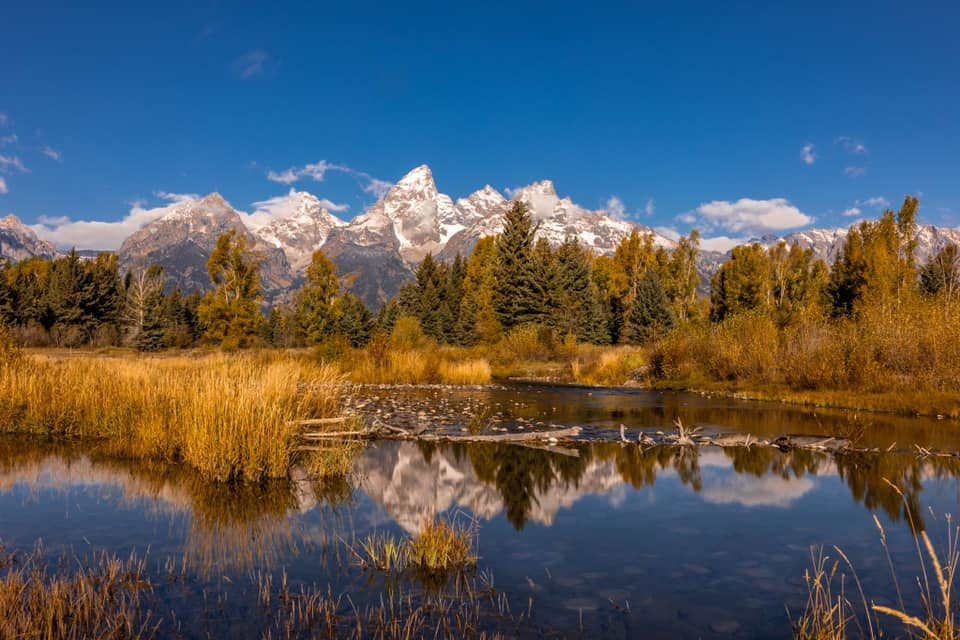
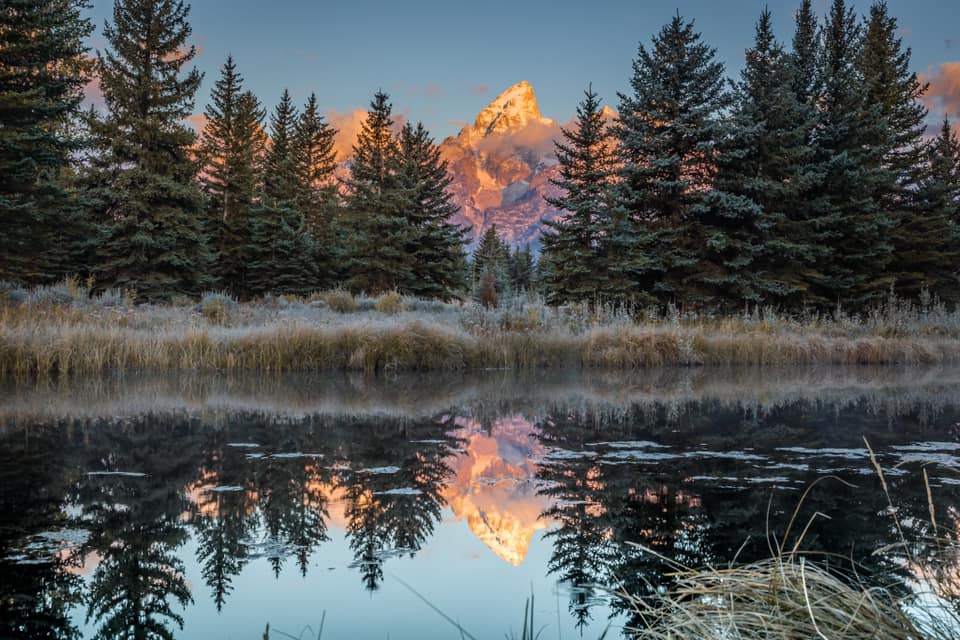
Rocky Mountain scenery offers dramatic vistas but few more impressive than the Teton skyline. As the Teton Range rose through sporadic earthquakes producing jolts, the valley called Jackson Hole subsided. Because of the way the mountains formed, no foothills hide jagged peaks and broad canyons. At the base of the range, large lakes mirror the mountains on calm summer days, doubling their prominence.
The ancient geologic processes that shaped the mountains and valley have left visible marks. Watch millions of years of dynamic geology unfold before you while exploring Grand Teton National Park.
Two rectangular blocks of the Earth's crust moved like giant trap doors, one swinging skyward to form the mountains, the other hinging downward to create the valley. Wind, rain, ice, and glaciers constantly eroded the rising range. Meanwhile, enormous glaciers and torrential meltwaters flowed southward carrying cobbles, gravel, and coarse sand and periodically re leveled the floor of the sinking valley.
During the immense span of time before the mountains' rise, vast seas repeatedly advanced and retreated, leaving behind a thick, nearly flat blanket of sedimentary rock layers. Between 60 and 70 million years ago, ancestral mountains rose here as a broad, northwest trending arch, and the last seas retreated eastward. Jackson Hole east of the arch became the site of enormous sheets of gravel interspersed with thick volcanic ash, lava and fresh water lake sediments. Enormous tensional faults fractured these formations, and 9 million years ago today's Teton Range started rising. Broken sedimentary layers of ancient sandstone, shale, dolomite and limestone still cap each end and the west side of the range. The sandstone remnant atop Mount Moran, over 6,000 feet above the valley, once connected to the same sandstone layer that now lies an estimated 24,000 feet below the valley floor block resulting from faulting process that created these mountains.
In addition to this great displacement along the Teton fault, the central peaks were thrust even higher, along fault zones within the range. Wind, water, ice and glaciers long ago stripped sedimentary layers off the central peaks, uncovering basement rock nearly as old as the Earth itself. Resistant granite, sculpted into the Grand Teton and adjacent peaks, towers as the central range's exposed core.
Cascading water initially cut steep, v-shaped gorges throughout the rising range. Changes in the Earth's climate caused long periods when snowfall exceeded melting, precipitating glaciers in sizes beyond imagination. Glaciers advanced and in warmer times receded in mountain gorges, and cut across the floor of Jackson Hole. Southward flowing ice more than 3,000 feet thick filled the valley, overriding buttes and surrounding mountains. Only the high Teton peaks protruded through engulfing ice. Mountain glaciers, particularly during the last Ice Age, widened steep gorges into broad, u-shaped canyons.
Over a comparatively short span of time, mountain glaciers of the last major glacial period shaped the Teton skyline more than any other erosional force. At upper elevations, where the most snow accumulated, the heads of the glaciers scooped out depressions, and frost wedging augmented their quarrying action. Sheer cirque walls, rugged ridges, and jagged peaks reflect the slow, dynamic carving by these great masses of moving ice.
Rocks of all sizes, falling onto and plucked by these moving glaciers, increased their grinding powers. The flanks of the range displayed scoured canyons that dive toward the valley. Upon leaving confining canyons, the larger glaciers spread onto the valley floor, while melting at a speed equal to their flow. An immense volume of unsorted rock, transported and dumped by these glaciers in a conveyor belt action, formed natural dams. These now encompass lakes called Leigh. Jenny, Taggart, Bradley and Phelps. Similarly a lobe of the extensive Yellowstone snowcap extended southward as a broad glacier that deposited rock as morainal ridges, damming meltwaters to create Jackson Lake.
South of Jackson Lake, torrential meltwaters spread cobbles and gravels to form broad terraces. Additions of loess (wind deposited silt) helped to form fair soils, but rainfall percolates rapidly through the underlying rocks. Sagebrush identifies these areas. Where glaciers transported and deposited unsorted rock as moraines, loams and silts below the soil help to retain water essential to stands of lodgepole pines and sub-alpine firs. High on alpine slopes, trees and flowers struggle in fragile soil, where harsh weather limits growth. At all elevations, geology and available water determine vegetation, which in turn controls the variety, abundance and distribution of wildlife.
At upper elevations a dozen smaller glaciers slowly flow from the cirques cut by the Ice Age giants. School-room Glacier, so named for its easily observable classic characteristics, represents but one page of the living textbook that includes the accessible rock of the Teton Range, Jackson Hole and adjoining features. This rock offers the most complete geologic record in North America. Future events will include infrequent earthquakes that signal movement along the fault zone as the Teton Range continues to rise and Jackson Hole drops down. Wind, water and ice will sculpt ancient rock into a different, but no less impressive skyline.

Copyright © 1995 - 2007 Hillclimb Media
Click Here to obtain Advertising Information on this Page
This site is in no way associated with the United States Government, the Department of the Interior or the National Park Service